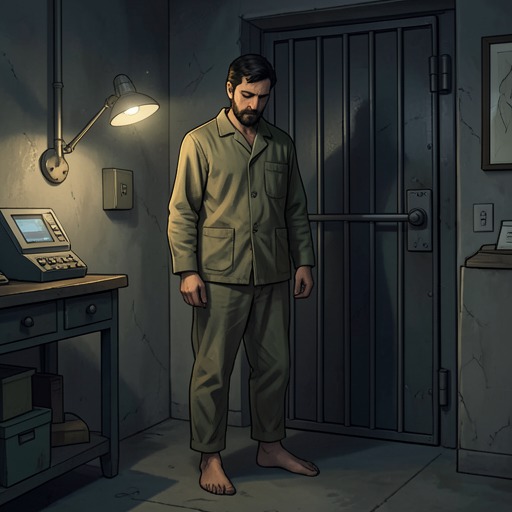
Staten Maximum Security Prison
The SonStaten Maximum Security Prison is the setting of Sonny Lofthus’s imprisonment and escape, but it is more than a secure enclosure: it is a place where confession, punishment, and competing claims to authority shape the lives of prisoners and staff. Its carefully engineered security coexists with a system in which Sonny offers absolution, an officer can manipulate access to care, and the prison’s own routines become part of the story’s struggle over control and accountability.
Design and Institutional Control
Staten was inspired by Lenzburg Prison in Switzerland, a modern institution designed to emphasize security and efficiency rather than comfort. Arild Franck had been involved in the prison’s creation, working with architects and international prison experts on its blueprint. He regards Staten as his own achievement and identifies himself closely with the institution, even though he is only assistant governor rather than the governor.
The building’s physical arrangements are designed to deny opportunities for escape. Staten has two floors and no lift, because lifts could create shafts and potential escape routes, while a fire and the confusion of evacuation might offer prisoners another opportunity. Electrical cables, fuse boxes, and water pipes are inaccessible to inmates, either kept outside the building or sealed into its walls. Franck’s insistence that nothing be left to chance establishes the prison’s ideal of security as comprehensive control over both architecture and daily life.
Control extends to possessions. The prison follows a Swiss model in which cells contain no unnecessary items and inmates may keep only twenty personal possessions. The limit makes ordinary comforts subject to calculation: an inmate who wants another pair of shoes must surrender two pairs of underpants or two books. Even a prayer rug, which Sonny uses when listening to a confession, stands out against the rule that such items are not permitted in other inmates’ cells.
Confession and Sonny’s Presence
Sonny’s reputation gives the prison a second, spiritual life. He is described as a model prisoner who listens to other inmates’ confessions and absolves them. Some prisoners whisper that he is not merely hearing about their crimes but serving time in their place. The distinction between listener and substitute offender is central to his reputation: inmates see him as someone willing to take their sins upon himself, while the circumstances of his own conviction make that belief seem plausible.
Gustav Rover visits Sonny before leaving Staten, hoping for a blessing before he walks out of prison and tries to change his life. Sonny has been silent through much of the encounter, then responds when Rover asks for a blessing. He directs Rover to kneel, recites a prayer for mercy and forgiveness, and rests a hand on his head. The exchange is conducted within the prison’s ordinary restrictions, with the prayer rug an unusual exception to the twenty-item rule. For Rover, the blessing offers peace of mind, even though he does not regard himself as religious or believe that Sonny’s touch has healing power.
The setting also makes Sonny’s own position sharply ambiguous. Other prisoners and staff know him through stories about his past, his reputation for absolution, and his apparent quietness; yet his confessional role does not mean that the prison can contain or define him. In the interview room, after his escape, he is questioned by Henrik Westad of Buskerud Police about a murder and answers the questions with terse confirmations. Staten’s routines and its controlled environment are thus connected to an identity that both officials and inmates struggle to interpret.
Escape, Return, and Institutional Failure
Staten’s security is tested when Sonny escapes. Franck expects most escaped prisoners to be returned within twelve hours and has told the press to expect a result within twenty-four. As the search passes the twenty-five-hour mark without a lead, the escape becomes a public and institutional crisis. The governor wants Sonny’s photograph circulated and the media informed; Franck has sought a media blackout to give the prison time to find him. The disagreement exposes how the escape threatens not only physical security but the institution’s public standing and its leadership’s competing interests.
The prison’s authority is also compromised by Franck’s treatment of inmates. When he suspects that Sonny may still be inside, he confronts Johannes Halden and threatens to withhold his cancer treatment unless Halden reveals where Sonny is. Halden refuses to give him the answer he wants, saying that his sins have been forgiven and that he has no one waiting outside. Franck’s threat turns access to medical care into leverage, making the prison’s custodial power personal rather than merely procedural.
After Halden helps Sonny escape, Franck carries out the threatened punishment. Halden remains in his cell without medical attention or pain relief as his cancer worsens. He reflects that the boy gave him what he wanted: forgiveness, and, in the form of heroin, a final means of easing his fear and suffering. The episode sets Sonny’s acts of mercy against Franck’s capacity to punish, showing how the same prison that administers formal custody also contains informal bargains and retaliations that evade any appearance of humane care.
The Prison as a Recurring Site of Conflict
Staten remains important after Sonny’s escape because he returns to confront Franck. Morgan Askøy, a prison officer who has worked there for two months, encounters a man in an officer’s uniform walking beside him on the way into the prison. The disguise carries Sonny back through the institution’s controlled threshold. Inside, he threatens Franck at gunpoint, binds him to his chair with duct tape, and takes his wallet and car key. Franck recognizes him as someone who has changed, but also remembers that, apart from an earlier incident involving Johannes Halden, Sonny had not displayed a tendency or ability to use violence while growing up in the prison.
The return unsettles the distinction between the institution’s officials and its captive. Franck had helped construct Staten as a place where security measures left little to chance; now Sonny enters in a prison officer’s uniform and turns Franck’s office into a scene of restraint. The reversal does not erase the prison’s power, but it shows that its systems can be penetrated and that the person who once lived under its rules can reappear with control over one of its senior officers.
At night, Staten’s cell doors lock simultaneously, and the corridors are watched by cameras. For Halden, the sound of the doors closing marks a quiet, isolating routine; he remembers that in an earlier prison, officers’ rounds and a guard’s singing had comforted inmates after lockdown. That contrast gives Staten’s security a human cost: surveillance and synchronized locks can secure the building, but they do not provide the reassurance that comes from a person’s presence. Across its recurring scenes, Staten therefore embodies both the state’s capacity to confine and the limits of treating security as a substitute for care, justice, or trust.